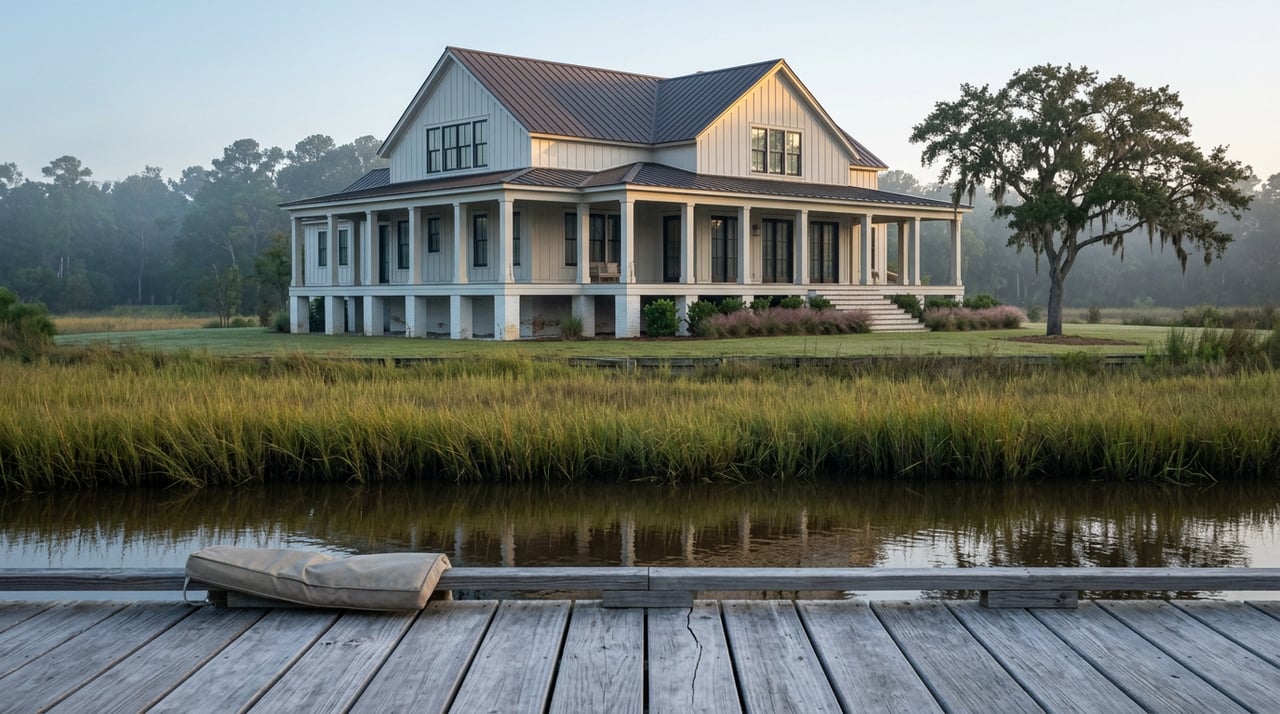
St. Simons Island Doesn't Have One Housing Market. It Has Four, and They're Stacked by the Water.
September 17, 2026
September 17, 2026
Pull up three different portals for St. Simons Island homes on the same afternoon and you'll get three different stories. One shows an average home value near $688,772, up modestly over the past year. Another, using a narrower three-month window through May 2026, puts the median sale price at $664,000, down almost 3 percent year over year. A third lists the median at $680,000. A fourth, focused only on single-family homes as of July 2026, puts the figure closer to $743,800.
None of these numbers is wrong. That's the part that trips people up. Each source is measuring a slightly different slice of an island that doesn't behave like one market at all. It behaves like four, stacked by their relationship to the water, and the gap between those four tiers is often wider than the gap between the highest headline number and the lowest one.
If you're comparing St. Simons Island against another Georgia coastal or suburban option, the single median you land on tells you almost nothing until you know which tier it came from.
Real estate professionals who work this island regularly describe pricing here in a strict order: oceanfront commands the top premium, marsh-front sits below that, canal-front below marsh, and inland properties, regardless of size or finish quality, sit at the base. Direct ocean access and a private dock can add somewhere between $200,000 and $500,000 over a comparable inland home. That's not a rounding difference. That's a second down payment.
Here's roughly how the tiers shake out based on current listings and recent sales activity:
| Tier | What you're paying for | Rough price signal |
|---|---|---|
| Oceanfront | Direct beach access, private dock potential, unobstructed water views | Single-family homes commonly exceed $1,000,000; currently listed waterfront inventory runs to a median around $787,000 with roughly 60 homes on the market |
| Marsh-front | Water views and tidal access without direct ocean exposure | Priced below oceanfront, above canal, with value tied heavily to protection from wind and erosion |
| Canal-front | Boat access via intracoastal channels, less exposed than open marsh or ocean | Mid-tier pricing, still a meaningful step above inland |
| Inland | No water frontage, but full access to the island's amenities, schools, and Village | Condos start around $400,000; inland single-family homes anchor the lower end of the island's range |
That ordering explains why the island-wide median moves depending on which homes happened to sell in a given month. A season heavy on oceanfront closings pulls the average up. A season heavy on inland condo turnover pulls it down. You're not watching a market rise or fall. You're watching the mix change.
Even inside the top tier, the spread is enormous. Two oceanfront properties a mile apart can differ by $500,000 based on factors that have nothing to do with square footage. Whether the shoreline is protected or exposed to open water. Whether the home faces sunrise or sunset. Water depth for boating access. Proximity to the Village versus a quieter, more remote stretch of beach.
Then there's the variable buyers underestimate most: shoreline condition. Oceanfront properties with stable shorelines and a documented, well-maintained bulkhead support premium pricing. Properties showing active erosion or an aging bulkhead face real buyer resistance, no matter how well the interior has been renovated. Marsh-front homes sidestep some of that erosion risk, but they come with their own tradeoffs, namely wildlife, insect pressure at certain times of year, and a different aesthetic than open ocean.
None of this shows up in a portal's headline median. It shows up in the inspection report and the seawall history, and it's exactly the kind of detail that separates a home that holds its value from one that doesn't.
St. Simons Island Club is a useful case study in how badly a thin market can distort a number. Recent neighborhood-level data has shown a median listing price above $1.5 million, with as few as 11 homes for sale at a time. Separate neighborhood sales data covering a recent three-month window showed only 3 homes sold, at a median sale price around $1,495,000, with an average of 77 days on market and a sale-to-list ratio under 90 percent.
Three sales is not a market. It's three data points wearing a market's clothing. In a neighborhood this thin, one unusually large estate selling or one distressed seller pricing below market can swing the "median" by tens of thousands of dollars in either direction. That's not a criticism of the data. It's a reminder that in a segment this small, the number is a snapshot of whoever happened to close, not a stable read on value.
Recent comparable sales analysis for luxury properties on the island requires looking back 12 to 24 months rather than the standard 6-month window, simply because there aren't enough transactions in a shorter span to draw a reliable comparison.
That single guideline probably matters more to a buyer or seller here than any headline median will.
Not every buyer coming to St. Simons Island is chasing a dock. Inland development gives you a clean look at what the island costs once you remove the waterfront variable entirely. Fifty Oaks, a gated enclave of 52 luxury townhomes near Bennie's Red Barn at the intersection of Sea Island Road and Frederica Road, is a good example. Units run around 2,188 square feet with three bedrooms, two and a half baths, quartz counters, and a clubhouse and pool overlooking one of two lakes on the property, all within a landscaped, gated setting under a canopy of oaks.
That's island living, full access to the Village, the beach, and everything else that draws people here, without the oceanfront or marsh-front premium layered on top. It's a useful anchor point if you're trying to figure out what you're actually paying for when a listing says "waterfront" versus one that doesn't.
Before you let any single median number set your expectations, ask these questions about the specific property or area you're considering:
As of early 2026, well-priced luxury properties on the island were landing close to their asking price, with strong offers coming in near the 94.5 percent of list mark for accurately priced homes. Overpriced listings, by contrast, tend to sit and eventually get corrected. The difference usually traces back to whether the original price reflected the right tier and the right comp set, not just the island's overall median.
Is oceanfront always the most expensive tier on St. Simons Island? Generally yes. The consistent ordering described by local real estate professionals runs oceanfront, then marsh-front, then canal-front, then inland, with direct ocean access and private dock potential adding the largest premium of any single feature.
Why do different websites show different median prices for the same month? Each source pulls from a different mix of closed sales, and because the island's tiers carry such different price points, a handful of oceanfront closings versus a handful of inland condo sales can shift the reported median significantly, even within the same reporting window.
How much extra should I expect to pay for a dock or direct water access? Recent guidance from professionals working this market points to roughly $200,000 to $500,000 added to a comparable inland home's value for direct ocean access and a private dock, though the exact number depends heavily on shoreline condition and location within the island.
Should I trust the median price in a specific neighborhood like St. Simons Island Club? Treat it carefully. With sales volumes as low as a handful of transactions in a given quarter, one or two closings can move that number substantially. A longer look-back window, ideally 12 to 24 months, gives a steadier picture than a single quarter.
The island's median price was never lying to you. It just was never built to answer the question you're actually asking, which is what a specific home, in a specific tier, on a specific stretch of shoreline, is really worth. That answer takes a closer look than any single portal number can give.
If you're weighing St. Simons Island against another Georgia coastal or move-up market and want a clearer read on which tier fits your goals and your budget, Ceirra Johnson can walk you through the comparison, tier by tier, before you anchor on a number that may not apply to the home you actually want. Reach out for a free home valuation and a conversation grounded in what's actually selling on this island right now, not just what the headline says.
Stay up to date on the latest real estate trends.
Enjoy your visit, and please don't hesitate to contact me if there’s anything I can do to make your next home-buying or selling experience the best it can be.